
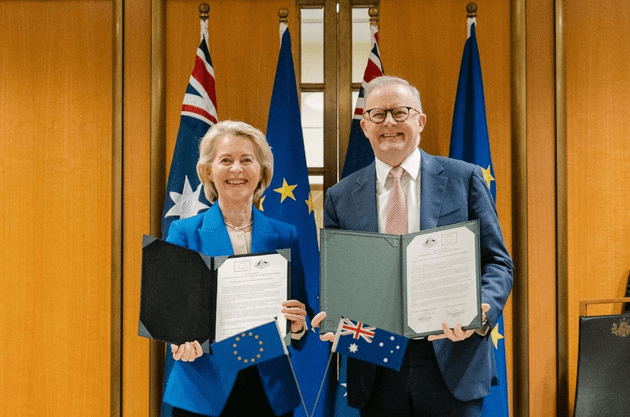
European Commission President Angela von der Leyen and Australian Prime Minister Anthony Albanese with their copies of the bilateral FTA document in Australia’s Parliament House today. Photo: Anthony Albanese
AUSTRALIA and the European Union have committed to a free trade agreement to end eight years of bilateral negotiations.
The agreement has drawn strong criticism from Australia’s farming organisations and red meat sector, but is yet to generate a murmur from the grains sector.
The EU has for many years been Australia’s biggest canola market, and buys varying quantities of durum, sometimes in bulk into Italy.
Australia exported 3.65 million tonnes (Mt) of canola seed to the EU in the year to September 2025 out of total exports of 5.4Mt, and Australian Oilseeds Federation manager Courtney Draper said Australian canola was not, and is not now, subject to an EU tariff.
“AOF supports continued dialogue and partnership between the two parties as they relate to this important market and trade, and the continued support of the Department of Agriculture, Fisheries and Forestry, and Australia’s agricultural counsellors,” Ms Draper said.
The big news for canola is that the FTA will set the tariff on Australian canola oil to zero from 5.1-9.6 percent currently.
Farm bodies critical
National Farmers Federation president Hamish McIntyre said the Australian Government has accepted an FTA which appears to offer no material change for key agricultural commodities to the draft it rejected in October 2023.
“Australian farmers are extremely disappointed that negotiations for a free trade deal with the EU have concluded without commercially meaningful agricultural market access gains since Australia last walked away from negotiations,” Mr McIntyre said.
“A deal with a market of this size offered an opportunity to help ease the pressure on farmers who are grappling with the impacts from the conflict in the Middle East, China’s beef tariffs, and United States trade volatility, which are creating global trade headwinds.
“Market access is the lifeblood of Australian farmers who do not rely on government subsidies.
“We are concerned the EU has offered subpar access for Australian producers while potentially needing to deploy billion-dollar subsidies to get their producers to accept the deal.
“This is exactly what happened when the EU signed a deal with the Mercosur nations, fast-tracking nearly $80 billion in farm subsidies, sending a clear signal protectionism is alive and well.”
Mr McIntyre said while the Australian Government cannot control other nations’ trade policies, it could pause its plan to increase export costs on industry through full cost recovery until global conditions stabilise.
“For farmers, no deal would have been better than what we’ve been dealt,” Victorian Farmers Federation president Brett Hosking said.
“At a time when farmers are getting smashed by devastating water buybacks and skyrocketing fuel and fertiliser costs, we’ve been hung out to dry for the sake of getting the deal done.”
Foods feature
A Federal Government statement lists wheat gluten and rice in the FTA as getting “commercially meaningful access” through new or expanded tariff-rate quota volumes that also cover red meat, sugar, skimmed milk powder, and natural butter.
With around 450 million people, the EU is the world’s second-largest economy, and the statement said the agreement will result in 98 percent of the current value of Australia’s exports entering the EU duty free.
“Australian farmers and producers will benefit from the elimination of almost all European Union tariffs on agricultural products,” the statement said.
“This includes wine, nuts, fruit and vegetables, honey, olive oil, most dairy products, wheat and barley, and seafood.
The FTA will remove most Australian tariffs on imports from the EU including wine, spirits, biscuits, chocolates, and pasta.
“Farmers and businesses will also benefit from cheaper motor vehicles and machinery.”
The FTA provides clarity around geographical indicators, such as preserving the right for Australian winemakers to keep making and selling Prosecco domestically.
Grandfathering and phase-out periods have been secured for a limited number of terms such as Feta, Romano and Gruyere.
The FTA will allow almost all Australian exports of manufactured goods and mineral resources to enter the EU with a zero import tariff.
“For example, the elimination of European Union tariffs on Australian critical minerals and hydrogen will support our ambition to become a renewable energy superpower and help stabilise supply chains.
Services to benefit
The EU was Australia’s second-largest source of foreign investment in 2024, and the FTA is expected to support investment in both directions.
“Australian companies, including small and medium-sized enterprises, will have better access to bid for lucrative European government contracts, worth around $845 billion annually, including for rail and construction.
Australian service providers will have greater market access to the EU, including in financial services, education, tourism, and communications, and Australian professionals will be able to travel to the EU more easily, and benefit from streamlined recognition of their qualifications.
Australian Prime Minister Anthony Albanese said the FTA demonstrated both parties’ commitment to open and rules-based trade.
“I am proud that we have been able to secure this deal, which will deliver benefits for both Australia and the European Union for generations to come,” Mr Albanese said.
Australia’s Minister for Trade and Tourism Don Farrell said the deal feeds into more trade with more trading partners, which will improve supply chain security and national income.
“This hard-fought deal delivers real commercial gains for Australian exporters, farmers and producers into a market that has been difficult to enter or effectively closed for decades,” Australia’s Minister for Trade and Tourism Don Farrell said.
“This is a strategically important and economically valuable agreement at a time when Australian exporters are navigating choppy trade waters.”
Mr Albanese and Mr Farrell, together with President of the European Commission Ursula von der Leyen and European Commissioner for Trade and Economic Security Maroš Šefčovič announced the conclusion of negotiations for the FTA today.
The FTA will enter into force when both Australia and the EU have completed their domestic processes.
Grain Trade Australia, Grains Australia, Grain Producers Australia and GrainGrowers have been contacted for comment.
Source: Federal Government, National Farmers Federation, Victorian Farmers Federation
HAVE YOUR SAY